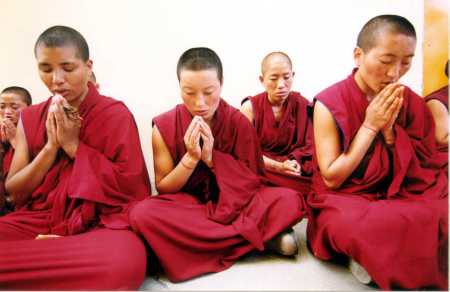
Buddhism is a faith highly accepting of women, who have important roles to play in the religion. The founder of Buddhism himself, Gautama Buddha, allowed women to embrace monasticism, something considered very progressive for the fifth century BC. To this day, however, there are certain rules that nuns have to follow and monks do not, called the “Eight Garudhammas.” Under these rules, monastic women are inferior to monks, as even “a nun who has been ordained even for a hundred years must greet respectfully, rise up from her seat, salute with joined palms, do proper homage to a monk ordained but that day.” This was amended during Gautama Buddha’s lifetime to apply only to monks deserving respect, but still remains within Buddhist canon. Some scholars maintain that this shows that the Garudhammas should be followed in the spirit in which they were intended, rather than to the letter.
Additionally, it is necessary to point out that the Eight Garudhammas allow women more freedom than fifth century BC Indian society did. In that society, women lived “under the care of parents in their childhood, under the protection of husbands in their youth; and in their old age they had to be under the control of their sons.” Becoming a housewife was the fate of most Indian women at the time. In Buddhism, while the same cultural values existed to a degree and go a long way in explaining why the Eight Garudhammas exist, women had much greater freedom, and were seen differently. Instead of being vulnerable creatures requiring protection, their role as a housewife was seen as one that required responsibility and skills that men did not possess.

from The Buddhist Channel
The level of enlightenment that a woman can reach is disputed, varying between branches of Buddhism. Theravada Buddhism, for instance, mentions women who have reached the ultimate state of Nirvana, while Mahayana Buddhist sutras state that a woman nearing enlightenment will reincarnate as male. In recent years, the number of Buddhist nuns has been on the rise, and the Dalai Lama himself expresses support for the full ordination of women in Tibetan Buddhism. In his words, ““Given that women are fully capable of achieving the ultimate goal of the Buddha’s teachings, in harmony with the spirit of the modern age, the means and opportunity to achieve this goal should be completely accessible to them.” One can only hope that the role of women within Buddhism will continue to grow in the future.
Dr. Karma Lekshe Tsomo discusses the role of women in Buddhism in the past and present.
The Dalai Lama is asked to visualize a world where all incarnations of the Dalai Lama and other important Buddhist figures have been female, and how he would feel.
Berzin, Dr. Alexander. “A Summary Report of the 2007 International Congress on the Woman’s Role in the Sangha.” The Berzin Archives, n.d. Web. 12 Dec. 2012
Finnegan, Damchö. “Press Release: Dalai Lama Announces ‘Full Support’ for Introduction of Full Ordination for Women in Tibetan Buddhism.” International Congress, n. d. Web. 12 Dec. 2012
Kabilsingh, Dr. Chatsumarn. “Buddhism and Women.” Buddha Dharma Education Association, n.d. Web 13 Dec. 2012
 The Role of Women In Religious Ceremonies